


THE ART AND RITUAL OF TEA OMAKASE
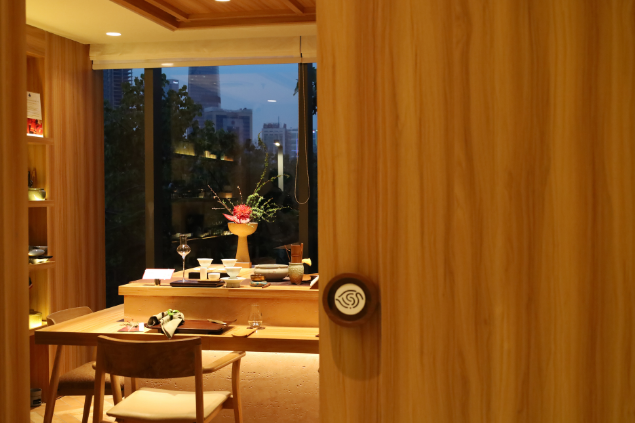
THE ART
AND
RITUAL OF TEA OMAKASE
When a Cup of Tea Becomes a Pause
In a city where time is often measured by appointments, meetings and meals squeezed between destinations, there is a kind of experience designed not to help us move faster, but to invite us to slow down. Here, a meal does not begin with the question, “What is the first course?” but with a moment of stillness. It does not end when the final dish leaves the table, but only when the guest has completed a journey composed through aroma, flavour, sound and memory.
This is the spirit of Tea Omakase at Quan Tea.
The Japanese word omakase derives from makaseru, meaning “to entrust” or “to place one’s trust in another’s choice”. In dining, it describes an experience in which guests surrender the conventional act of choosing each dish, placing their trust instead in the chef to guide them through a menu shaped by seasonality, ingredients and the sensibility of the day. Yet when the spirit of omakase enters the world of tea, the concept takes on another dimension: tea is no longer simply a beverage served alongside a meal. It becomes part of the architecture of the experience, guiding the rhythm of each course and shaping the way the guest perceives the journey as a whole.
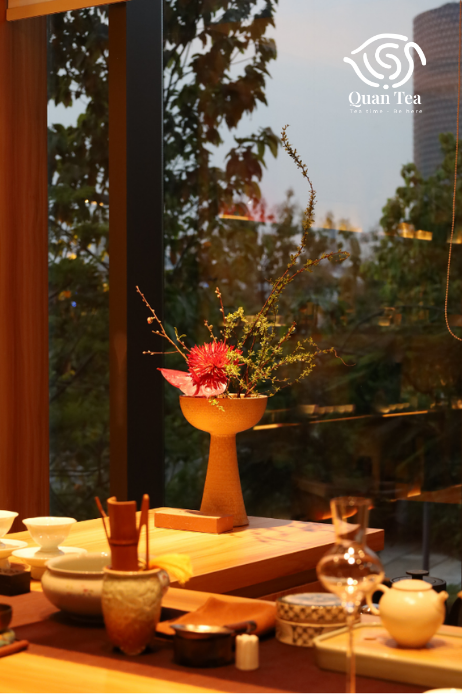
At Quan Tea, Tea Omakase is not simply a tasting menu consisting of a succession of dishes. It is a sensory flow, in which tea, plant-based cuisine, sound, space and carefully considered rituals are woven together into a deliberate experience. Each cup becomes a moment of pause; each dish, a new chapter; and between these chapters lie moments of stillness long enough for the guest to realise that they are not merely having a meal, but entering another way of experiencing time.
A MEAL BEGINS BEFORE THE FIRST DISH ARRIVES
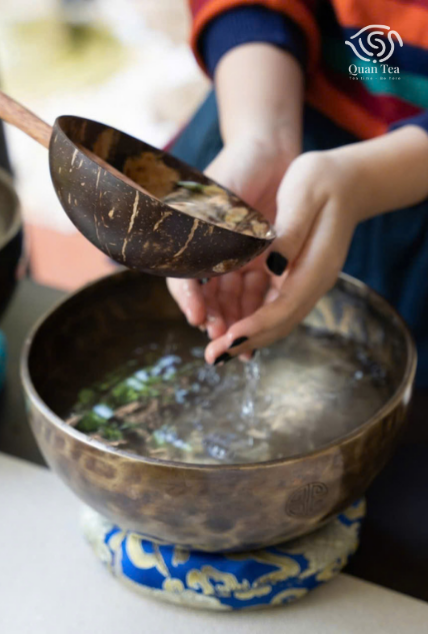
At Quan Tea, the Tea Omakase journey begins with a gesture that appears almost deceptively simple: the ritual of washing one’s hands.
Across many Asian cultures, the hands have long carried an association with cleanliness and preparation. Before touching something precious, entering a sacred space or taking part in a ritual, people have traditionally cleansed their hands as a way of leaving the traces of the outside world behind. At Quan Tea, this gesture is woven into the Omakase experience not as theatrical performance, but as a quiet invitation to cross an invisible threshold.
From this moment, hurried conversations, phone notifications and the relentless rhythm of the city may be left behind.
The journey begins here.
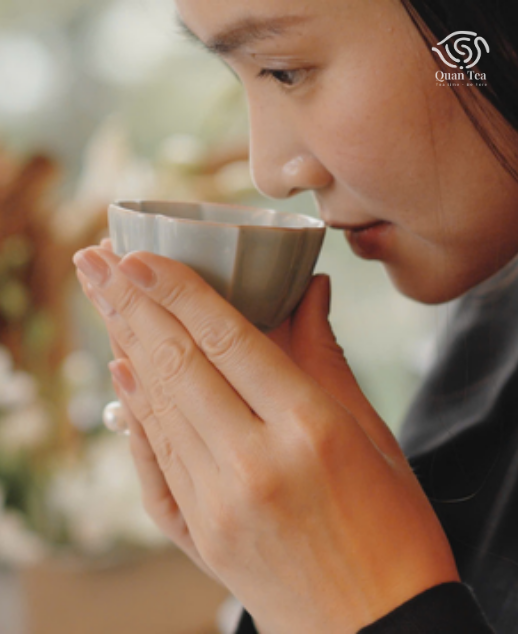
The ritual of hand washing is followed by the appreciation of aroma—a transition from touch to scent, where the guest begins to encounter the language of tea before tasting it. The dry aroma of the leaves, with its notes of flowers, wood, fruit, herbs or minerals, is brought gently into focus. The purpose is not to identify every note correctly, but to awaken a faculty of attention that modern life so often leaves dormant.
Before tea reaches the palate, its story has already begun through fragrance.
And then, the bell rings.
A bell is more than a sound announcing the beginning of a meal. At Quan Tea, each chime marks the opening of a new culinary journey. Its resonance moves through the space, creating a moment of stillness in which the guest transitions from observation to awareness. It is a moment when time seems to return to zero, allowing everything that follows to be received with a different state of mind.
If an ordinary meal is marked by the arrival of a dish, Tea Omakase is marked by the movement of sensation.
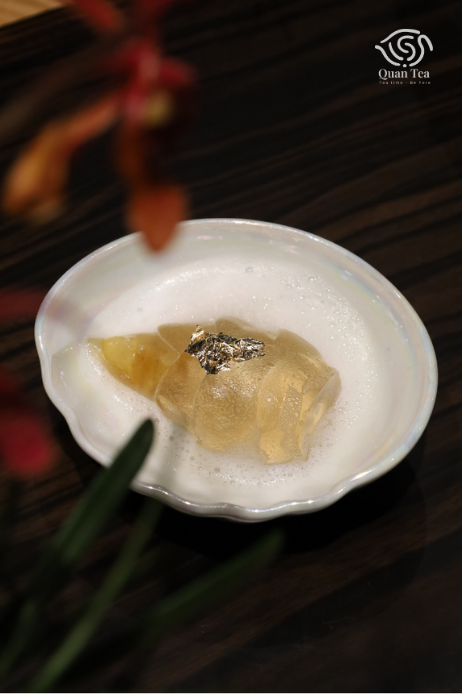
FLOW — WHEN A MENU FOLLOWS A CURRENT RATHER THAN A SEQUENCE
One of the defining differences between Tea Omakase and a conventional meal lies in the way the menu is conceived.
At Quan Tea, the menu is not simply a list of dishes placed beside one another. It is designed as a Flow—a continuous current with an opening, a rising point, moments of repose and, finally, a conclusion. Each dish appears at its own precise moment, guided not only by the progression of flavours, but also by the way the body and the senses receive the experience.
A meal may begin with something light and transparent, gradually moving towards deeper and more complex flavours before returning to a clean and graceful finish. Tea plays an essential role in regulating this movement. At times, it opens the palate with a bright and delicate structure; at others, it acts as a bridge between two courses; and in certain moments, it serves to refresh the palate, returning the senses to a state of balance before the next chapter begins.
Tea Omakase, therefore, is not a collection of independent dishes.
It is a story told continuously.
What gives this story its vitality is its relationship with the seasons. The Omakase menu at Quan Tea draws inspiration from the changing natural world, from local ingredients at their most expressive and from the distinct palette of flavours that each season brings.
One season may be defined by the freshness of early fruits, the green clarity of young vegetables, the delicate fragrance of flowers or local ingredients reaching their natural peak. Another may bring the menu towards deeper, warmer notes, with greater expressions of earth, wood and mineral character.
Here, seasonality is not a slogan.
It is a creative principle.
When ingredients are used at the right moment in their natural cycle, the chef does not need to impose too much upon them to create flavour. The more important task is to recognise the inherent qualities of each ingredient and find the tea that allows those qualities to speak more clearly.
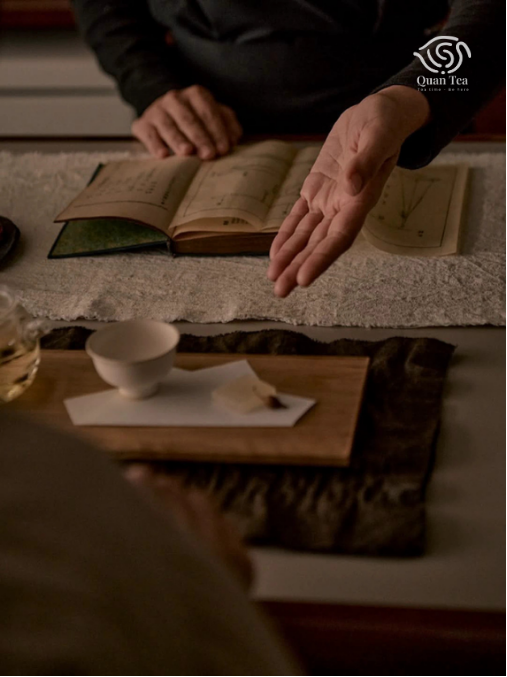
In a conventional meal, a beverage is often chosen according to personal preference or consumed simply to refresh the palate between courses. In Tea Omakase, tea assumes a more active role.
It may stimulate a particular flavour, bring forward an aromatic layer that might otherwise remain unnoticed, or create harmony between ingredients that initially appear to stand in contrast.
A tea with a clean astringency and mineral structure may refresh the palate after a dish rich in natural oils, allowing the senses to become brighter and more receptive before the next course. A tea with delicate floral notes may extend the natural fragrance of a plant-based ingredient, allowing the aroma to linger long after the dish itself has disappeared. Another tea, carrying deeper notes of roast, wood or ripe fruit, may create an entirely new foundation, bringing the dish into another sensory landscape.
This is the art of Tea Pairing.
WHEN TEA DOES NOT SIMPLY ACCOMPANY THE FOOD
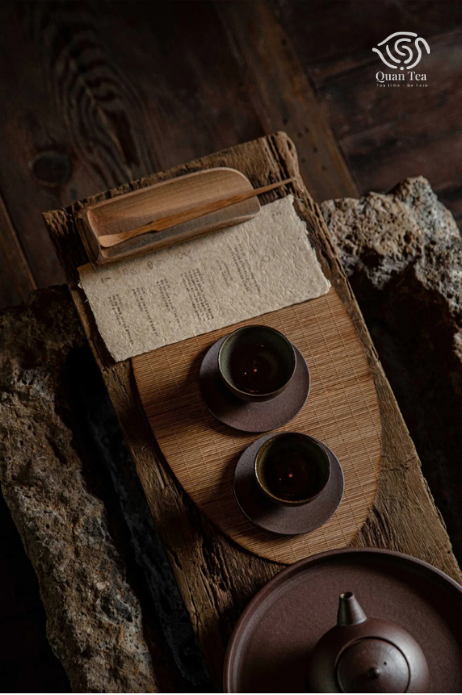
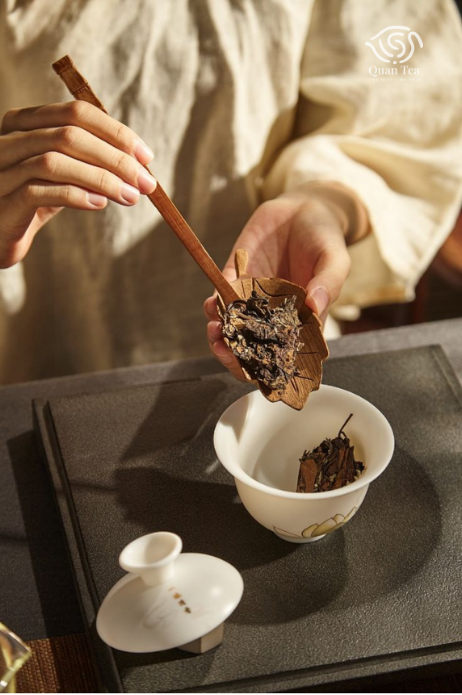
“Tea pairing is not about finding a tea that resembles the dish. It is about discovering the moment when tea and food reveal something in each other that neither could express alone.”
The relationship is not simply about finding flavours that resemble one another. Sometimes harmony emerges through contrast. A dish with natural sweetness may become more graceful when paired with a tea of gentle astringency. An aromatic dish may gain greater depth from a tea with a lingering mineral finish. And sometimes, it is the distance between two flavours that creates the most compelling encounter.
At Quan Tea, tea and food are placed within the same sensory framework, where each has the ability to alter the way the other is perceived.
That is why a cup of tea in a Tea Omakase experience never appears by accident.
It appears for a reason.
And sometimes, that reason only becomes fully understood when the next course arrives.
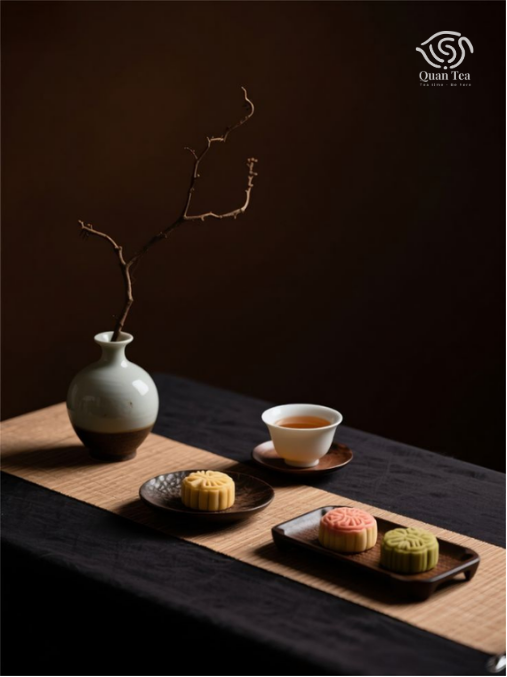
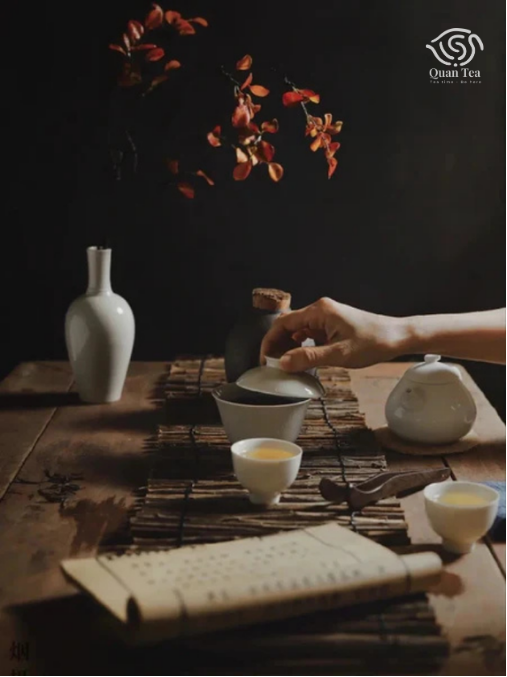
“Tea does not simply accompany food.
It changes the way we experience it.”
A CUP OF TEA,
A MOMENT OF PAUSE
Perhaps the most remarkable quality of Tea Omakase lies not in the number of courses or the complexity of the techniques involved, but in the way the experience asks us to slow down.
In modern life, we have become accustomed to filling every empty space. A moment of silence is quickly replaced by the glow of a phone screen. A short journey becomes an opportunity to answer emails. A meal may unfold while the mind remains somewhere else entirely.
Tea Omakase chooses the opposite path.
Between two dishes, there is a cup of tea.
Between two layers of aroma, there is a moment of stillness.
Between two chapters of the journey, there is the sound of a bell.
These pauses are not empty spaces within the experience. They are the experience.
Because the palate needs time to remember.
An aftertaste cannot truly be perceived if one rushes immediately towards the next course. A delicate fragrance cannot reveal itself without a quiet moment in which to exist. And a truly meaningful culinary experience cannot unfold if the guest is never given the opportunity to pause and recognise what they have just experienced.
At Quan Tea, each cup of tea is therefore conceived as an ideal moment of pause.
Not long enough to interrupt the flow.
Not brief enough to be overlooked.
Just enough for one flavour to settle, one sensation to fade gently and another chapter to begin.
OMAKASE IS THE ART OF TRUST
Ultimately, perhaps the essence of Tea Omakase lies not in what the guest knows in advance, but in what they are willing to leave behind.
They do not need to know exactly what the next course will be. They do not need to know which tea will appear after the next chime. They do not need to make every decision themselves.
Instead, they place their trust in the chef, tea master and service team—the people who have devoted time to studying ingredients, seasonality, flavour and the rhythm of the experience as a whole.
This trust is the foundation of Omakase.
It is also why no Tea Omakase experience at Quan Tea is ever entirely identical to another.
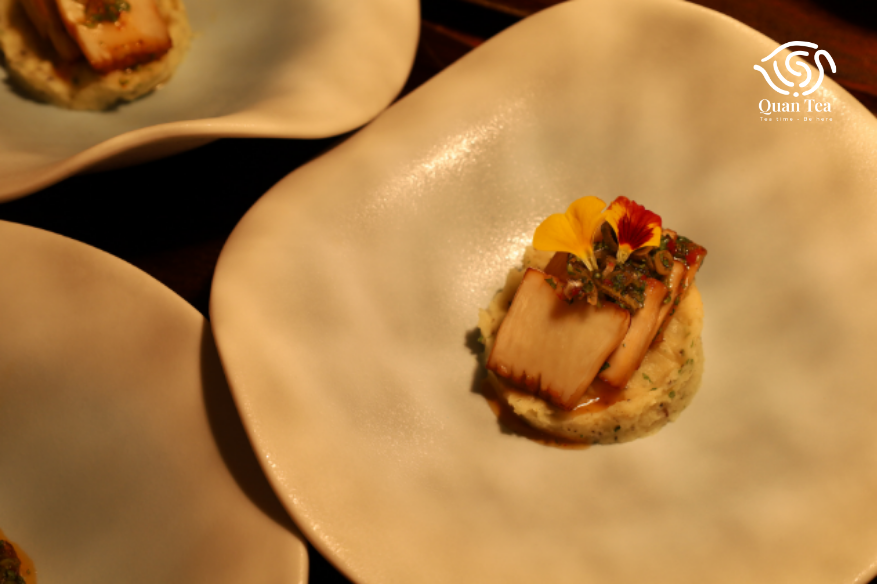
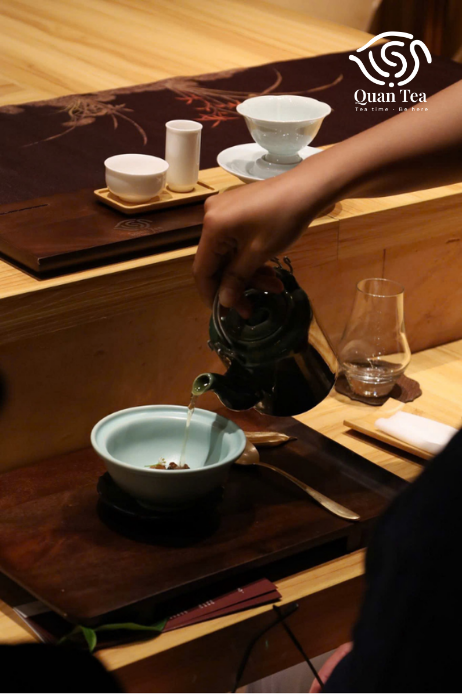
“A bell begins a journey. A cup of tea closes a chapter.
And between the two, there is enough time to truly be present.”
Nature does not repeat itself. Seasons shift. Ingredients change. Tea evolves. And the guest, too, enters each experience with a different state of mind.
What remains is a flow carefully designed to embrace all these changes.
From the ritual of washing one’s hands and the first encounter with dry aroma, to the sound of the opening bell and the succession of teas that accompany each course through the rhythm of Flow, Tea Omakase at Quan Tea is an invitation to step outside the ordinary pace of life for a few unhurried hours.
To eat more slowly.
To drink more deeply.
To listen more carefully.
And to realise that perhaps the greatest luxury a culinary experience can offer is not extravagance, but the gift of time fully inhabited.
A bell rings.
A cup of tea is poured.
A dish arrives.
And between all these moments, there is a pause just long enough to remind us that we are here.
Right now.